Showing posts with label Aristotle. Show all posts

Sunday, 8 November 2020

The Certainty of Uncertainty


Posted by Keith Tidman
 

We favour certainty over uncertainty. That’s understandable. Our subscribing to certainty reassures us that perhaps we do indeed live in a world of absolute truths, and that all we have to do is stay the course in our quest to stitch the pieces of objective reality together.


We imagine the pursuit of truths as comprising a lengthening string of eureka moments, as we put a check mark next to each section in our tapestry of reality. But might that reassurance about absolute truths prove illusory? Might it be, instead, ‘uncertainty’ that wins the tussle?


Uncertainty taunts us. The pursuit of certainty, on the other hand, gets us closer and closer to reality, that is, closer to believing that there’s actually an external world. But absolute reality remains tantalizingly just beyond our finger tips, perhaps forever.


And yet it is uncertainty, not certainty, that incites us to continue conducting the intellectual searches that inform us and our behaviours, even if imperfectly, as we seek a fuller understanding of the world. Even if the reality we think we have glimpsed is one characterised by enough ambiguity to keep surprising and sobering us.


The real danger lies in an overly hasty, blinkered turn to certainty. This trust stems from a cognitive bias — the one that causes us to overvalue our knowledge and aptitudes. Psychologists call it the Dunning-Kruger effect.


What’s that about then? Well, this effect precludes us from spotting the fallacies in what we think we know, and discerning problems with the conclusions, decisions, predictions, and policies growing out of these presumptions. We fail to recognise our limitations in deconstructing and judging the truth of the narratives we have created, limits that additional research and critical scrutiny so often unmask. 


The Achilles’ heel of certainty is our habitual resort to inductive reasoning. Induction occurs when we conclude from many observations that something is universally true: that the past will predict the future. Or, as the Scottish philosopher, David Hume, put it in the eighteenth century, our inferring ‘that instances of which we have had no experience resemble those of which we have had experience’. 


A much-cited example of such reasoning consists of someone concluding that, because they have only ever observed white swans, all swans are therefore white — shifting from the specific to the general. Indeed, Aristotle uses the white swan as an example of a logically necessary relationship. Yet, someone spotting just one black swan disproves the generalisation. 


Bertrand Russell once set out the issue in this colourful way:


‘Domestic animals expect food when they see the person who usually feeds them. We know that all these rather crude expectations of uniformity are liable to be misleading. The man who has fed the chicken every day throughout its life at last wrings its neck instead, showing that more refined views as to uniformity of nature would have been useful to the chicken’.


The person’s theory that all swans are white — or the chicken’s theory that the man will continue to feed it — can be falsified, which sits at the core of the ‘falsification’ principle developed by philosopher of science Karl Popper. The heart of this principle is that in science a hypothesis or theory or proposition must be falsifiable, that is, to possibly being shown wrong. Or, in other words, to be testable through evidence. For Popper, a claim that is untestable is no longer scientific. 


However, a testable hypothesis that is proven through experience to be wrong (falsified) can be revised, or perhaps discarded and replaced by a wholly new proposition or paradigm. This happens in science all the time, of course. But here’s the rub: humanity can’t let uncertainty paralyse progress. As Russell also said: 


‘One ought to be able to act vigorously in spite of the doubt. . . . One has in practical life to act upon probabilities’.


So, in practice, whether implicitly or explicitly, we accept uncertainty as a condition in all fields — throughout the humanities, social sciences, formal sciences, and natural sciences — especially if we judge the prevailing uncertainty to be tiny enough to live with. Here’s a concrete example, from science.


In the 1960s, the British theoretical physicist, Peter Higgs, mathematically predicted the existence of a specific subatomic particle. The last missing piece in the Standard Model of particle physics. But no one had yet seen it, so the elusive particle remained a hypothesis. Only several decades later, in 2012, did CERN’s Large Hadron Collider reveal the particle, whose field is claimed to have the effect of giving all other particles their mass. (Earning Higgs, and his colleague Francis Englert, the Nobel prize in physics.)


The CERN scientists’ announcement said that their confirmation bore ‘five-sigma’ certainty. That is, there was only 1 chance in 3.5 million that what was sighted was a fluke, or something other than the then-named Higgs boson. A level of certainty (or of uncertainty, if you will) that physicists could very comfortably live with. Though as Kyle Cranmer, one of the scientists on the team that discovered the particle, appropriately stresses, there remains an element of uncertainty: 


“People want to hear declarative statements, like ‘The probability that there’s a Higgs is 99.9 percent,’ but the real statement has an ‘if’ in there. There’s a conditional. There’s no way to remove the conditional.”


Of course, not in many instances in everyday life do we have to calculate the probability of reality. But we might, through either reasoning or subconscious means, come to conclusions about the likelihood of what we choose to act on as being right, or safely right enough. The stakes of being wrong matter — sometimes a little, other times consequentially. Peter Higgs got it right; Bertrand Russell’s chicken got it wrong.


The takeaway from all this is that we cannot know things with absolute epistemic certainty. Theories are provisional. Scepticism is essential. Even wrong theories kindle progress. The so-called ‘theory of everything’ will remain evasively slippery. Yet, we’re aware we know some things with greater certainty than other things. We use that awareness to advantage, informing theory, understanding, and policy, ranging from the esoteric to the everyday.


Sunday, 19 January 2020

Environmental Ethics and Climate Change

Posted by Keith Tidman

The signals of a degrading environment are many and on an existential scale, imperilling the world’s ecosystems. Rising surface temperature. Warming oceans. Sinking Greenland and Antarctic ice sheets. Glacial retreat. Decreased snow cover. Sea-level rise. Declining Arctic sea ice. Increased atmospheric water vapour. Permafrost thawing. Ocean acidification. And not least, supercharged weather events (more often, longer lasting, more intense).

Proxy (indirect) measurements — ice cores, tree rings, corals, ocean sediment — of carbon dioxide, a heat-trapping gas that plays an important role in creating the greenhouse effect on Earth, have spiked dramatically since the beginning of the Industrial Revolution. The measurements underscore that the recent increase far exceeds the natural ups and downs of the previous several hundred thousand years. Human activity — use of fossil fuels to generate energy and run industry, deforestation, cement production, land use changes, modes of travel, and much more — continues to be the accelerant.

The reports of the United Nations’ Intergovernmental Panel on Climate Change, contributed to by some 1,300 independent scientists and other researchers from more than 190 countries worldwide, reported that concentrations of carbon dioxide, methane, and nitrous oxides ‘have increased to levels unprecedented in at least 800,000 years’. The level of certainty of human activity being the leading cause, referred to as anthropogenic cause, has been placed at more than 95 percent.

That probability figure has legs, in terms of scientific method. Early logical positivists like A.J. Ayer had asserted that for validity, a scientific proposition must be capable of proof — that is, ‘verification’. Later, however, Karl Popper, in his The Logic of Scientific Discovery, argued that in the case of verification, no number of observations can be conclusive. As Popper said, no matter how many instances of white swans we may have observed, this does not justify the conclusion that all swans are white. (Lo and behold, a black swan shows up.) Instead, Popper said, the scientific test must be whether in principle the proposition can be disproved — referred to as ‘falsification’. Perhaps, then, the appropriate test is not ability to prove that mankind has affected the Earth’s climate; rather, it’s incumbent upon challengers to disprove (falsify) such claims. Something that  hasn’t happened and likely never will.

As for the ethics of human intervention into the environment, utilitarianism is the usual measure. That is to say, the consequences of human activity upon the environment govern the ethical judgments one makes of behavioural outcomes to nature. However, we must be cautious not to translate consequences solely in terms of benefits or disadvantages to humankind’s welfare; our welfare appropriately matters, of course, but not to the exclusion of all else in our environment. A bias to which we have often repeatedly succumbed.

The danger of such skewed calculations may be in sliding into what the philosopher Peter Singer coined ‘speciesism’. This is where, hierarchically, we place the worth of humans above all else in nature, as if the latter is solely at our beck and call. This anthropocentric favouring of ourselves is, I suggest, arbitrary and too narrow. The bias is also arguably misguided, especially if it disregards other species — depriving them of autonomy and inherent rights — irrespective of the sophistication of their consciousness. To this point, the 18th/19th-century utilitarian Jeremy Bentham asserted, ‘Can [animals] feel? If they can, then they deserve moral consideration’.

Assuredly, human beings are endowed with cognition that’s in many ways vastly more sophisticated than that of other species. Yet, without lapsing into speciesism, there seem to be distinct limits to the comparison, to avoid committing what’s referred to as a ‘category mistake’ — in this instance, assigning qualities to species (from orangutans and porpoises to snails and amoebas) that belong only to humans. In other words, an overwrought egalitarianism. Importantly, however, that’s not the be-all of the issue. Our planet is teeming not just with life, but with other features — from mountains to oceans to rainforest — that are arguably more than mere accouterments for simply enriching our existence. Such features have ‘intrinsic’ or inherent value — that is, they have independent value, apart from the utilitarianism of satisfying our needs and wants.

For perspective, perhaps it would be better to regard humans as nodes in what we consider a complex ‘bionet’. We are integral to nature; nature is integral to us; in their entirety, the two are indissoluble. Hence, while skirting implications of panpsychism — where everything material is thought to have at least an element of consciousness — there should be prima facie respect for all creation: from animate to inanimate. These elements have more than just the ‘instrumental’ value of satisfying the purposes of humans; all of nature is itself intrinsically the ends, not merely the means. Considerations of aesthetics, culture, and science, though important and necessary, aren’t sufficient.

As such, there is an intrinsic moral imperative not only to preserve Earth, but for it and us jointly to flourish — per Aristotle’s notion of ‘virtue’, with respect and care, including for the natural world. It’s a holistic view that concedes, on both the utilitarian and intrinsic sides of the moral equation, mutually serving roles. This position accordingly pushes back against the hubristic idea that human-centricism makes sense if the rest of nature collectively amounts only to a backstage for our purposes. That is, a backstage that provides us with a handy venue where we act out our roles, whose circumstances we try to manage (sometimes ham-fistedly) for self-satisfying purposes, where we tinker ostensibly to improve, and whose worth (virtue) we believe we’re in a position to judge rationally and bias-free.

It’s worth reflecting on a thought experiment, dubbed ‘the last man’, that the Australian philosopher Richard Routley introduced in the 1970s. He envisioned a single person surviving ‘the collapse of the world system’, choosing to go about eliminating ‘every living thing, animal and plant’, knowing that there’s no other person alive to be affected. Routley concluded that ‘one does not have to be committed to esoteric values to regard Mr. Last Man as behaving badly’. Whether Last Man was, or wasn’t, behaving unethically goes to the heart of intrinsic versus utilitarian values regarding nature —and presumptions about human supremacy in that larger calculus.

Groups like the UN Intergovernmental Panel on Climate Change have laid down markers as to tipping points beyond which extreme weather events might lead to disastrously runaway effects on the environment and humanity. Instincts related to the ‘tragedy of the commons’ — where people rapaciously consume natural resources and pollute, disregarding the good of humanity at large — have not yet been surmounted. That some other person, or other community, or other country will shoulder accountability for turning back the wave of environmental destruction and the upward-spiking curve of climate extremes has hampered the adequacy of attempted progress. Nature has thrown down the gauntlet. Will humanity pick it up in time?

Sunday, 8 December 2019

Is Torture Morally Defensible?


Posted by Keith Tidman

Far from being unconscionable, today one metric of how societies have universalised torture is that, according to Amnesty International, some 140 countries resort to it: whether for use by domestic police, intelligence agencies, military forces, or other institutions. Incongruously, many of these countries are signatories to the United Nations Convention Against Torture, the one that forbids torture, whether domestic or outsourced to countries where torture is legal (by so-called renditions).

Philosophers too are ambivalent, conjuring up difficult scenarios in which torture seems somehow the only reasonable response:
An anarchist knows the whereabouts of a powerful bomb set to kill scores of civilians.
A kidnapper has hidden a four-year-old in a makeshift underground box, holding out for a ransom.
Or perhaps an authoritarian government, feeling threatened, has identified the ringleader of swelling political street opposition, and wants to know his accomplices’ names. Soldiers have a high-ranking captive, who knows details of the enemy’s plans to launch a counteroffensive. A kingpin drug supplier, and his metastasized network of street traffickers, routinely distributes highly contaminated drugs, resulting in a rash of deaths...

Do any of these hypothetical and real-world events, where information needs to be extracted for urgent purposes, rise to the level of resorting to torture? Are there other examples to which society ought morally consent to torture? If so, for what purposes? Or is torture never morally justified?

One common opinion is that if the outcome of torture is information that saves innocent lives, the practice is morally justified. I would argue that there are at least three aspects to this claim:
  • the multiple lives that will be saved (traded off against the fewer), sometimes referred to as ‘instrumental harm’; 
  • the collective innocence, in contrast to any aspect of culpability, of those people saved from harm; and
  • the overall benefit to society, as best can credibly be predicted with information at hand.
The 18th-century philosopher Jeremy Bentham’s famous phrase that ‘It is the greatest good for the greatest number of people which is the measure of right and wrong’ seems to apply here. Historically, many people have found, rightly or not, that this principle of ‘greatest good for the greater number’ rises to the level of common sense, as well as proving simpler to apply in establishing one’s own life doctrine than from competitive standards — such as discounting outcomes for chosen behaviours.

Other thinkers, such as Joseph Priestley (18th century) and John Stuart Mill (19th century), expressed similar utilitarian arguments, though using the word ‘happiness’ rather than ‘benefit’. (Both terms might, however, strike one as equally cryptic.) Here, the standard of morality is not a rulebook rooted in solemnised creed, but a standard based in everyday principles of usefulness to the many. Torture, too, may be looked at in those lights, speaking to factors like human rights and dignity — or whether individuals, by virtue of the perceived threat, forfeit those rights.

Utilitarianism has been criticised, however, for its obtuse ‘the ends justify the means’ mentality — an approach complicated by the difficulty of predicting consequences. Similarly, some ‘bills of rights’ have attempted to provide pushback against the simple calculus of benefiting the greatest number. Instead, they advance legal positions aimed at protecting the welfare of the few (the minority) against the possible tyranny of the many (the majority). ‘Natural rights’ — the right to life and liberty — inform these protective constitutional provisions.

If torture is approved of in some situations — ‘extreme cases’ or ‘emergencies’, as society might tell itself — the bar in some cases might lower. As a possible fast track in remedying a threat — maybe an extra–judicial fast track — torture is tempting, especially when used ‘for defence’. However, the uneasiness is in torture turning into an obligation — if shrouded in an alleged moral imperative, perhaps to exploit a permissive legal system. This dynamic may prove alluring if society finds it expeditious to shoehorn more cases into the hard-to-parse ‘existential risk’.

What remains key is whether society can be trusted to make such grim moral choices — such as those requiring the resort to torture. This blurriness has propelled some toward an ‘absolutist’ stance, censuring torture in all circumstances. The French poet Charles Baudelaire felt that ‘Torture, as the art of discovering truth, is barbaric nonsense’. Paradoxically, however, absolutism in the total ban on torture might itself be regarded as immoral, if the result is death of a kidnapped child or of scores of civilians. That said, there’s no escaping the reality that torture inflicts pain (physical and/or mental), shreds human dignity, and curbs personal sovereignty. To some, many even, it thus must be viewed as reprehensible and irredeemable — decoupled from outcomes.

This is especially apparent if torture is administered to inflict pain, terrorise, humiliate, or dehumanise for purposes of deterrence or punishment. But even if torture is used to extract information — information perhaps vital, as per the scenarios listed at the beginning — there is a problem: the information acquired is suspect, tales invented just to stop pain. Long ago, Aristotle stressed this point, saying plainly: ‘Evidence from torture may be considered utterly untrustworthy’. Even absolutists, however, cannot skip being involved in defining what rises to the threshold of clearer-cut torture and what perhaps falls just below  grist for considerable contentious debate.

The question remains: can torture ever be justified? And, linked to this, which moral principles might society want to normalise? Is it true, as the French philosopher Jean-Paul Sartre noted, that ‘Torture is senseless violence, born in fear’? As societies grapple with these questions, they reduce the alternatives to two: blanket condemnation of torture (and acceptance of possible dire, even existential consequences of inaction); or instead acceptance of the utility of torture in certain situations, coupled with controversial claims about the correct definitions of the practice.


I would argue one might morally come down on the side of the defensible utility of the practice  albeit in agreed-upon circumstances (like some of those listed above), where human rights are robustly aired side by side with the exigent dangers, potential aftermaths of inertia, and hard choices societies face.

Sunday, 30 September 2018

Picture Post #38 What Happened Next to the White Rabbit


'Because things don’t appear to be the known thing; they aren’t what they seemed to be neither will they become what they might appear to become.'

Posted by Tessa den Uyl and Martin Cohen

A shop window in Paris, captured en passant by Tessa den Uyl
      
This cozy scene reminiscient of Lewis Carroll's imaginary ‘wonderland’, is in fact, something rather more grim.

No surprise would fall upon us to discover a boar’s head hanging on the wall in a hunter’s lodge. But most often today, to encounter embalmed animals in non-rural houses reminds of gestures of excess that echo as non-virtuous.

This shop window in the centre of Paris offers a sitting room full of real dead animals. Yet perhaps it is not the embalmed animals that particularly draw the attention here, but rather the way that they are displayed with more or less anthropomorphic features.

The White Rabbit, in Lewis Carroll's famous story, Alice in Wonderland, occupies a particular role: he appears at the very beginning of the book, in chapter one, wearing a waistcoat, carrying a pocket watch, and in a great hurry muttering ‘Oh dear! Oh dear! I shall be too late!’ And Alice encounters him again at a stressful moment in the adventure when she finds herself trapped in his house after growing too large.

Most emblematic of all though, the Rabbit  reappears as a servant of the King and Queen of Hearts in the closing chapters of the book, reading out bizarre verses as ‘evidence' against Alice. In this scene, the stuffed white rabbit, too, seems to have a prosecutorial air, rather as though the animal is a judge surrounded by courtroom flunkeys.

In Alice’s case, the White Rabbit’s case for the prosecution is so convincing that the Queen of Hearts immediately announces ‘Off with her head!’ at which point, mercifully, Alice wakes up. In this real-life shop, too, a similar return to earth is marked by a neatly framed message held by the only fake animal in the shop.  It notifies the observer that all the animals have died naturally in zoos or zoological parks. Potential clients can presumably put their consciences to ease.

Aristotle mentioned that art is a representation of life, of character, of emotion and actions, and in contemporary art, animals in formaldehyde are exhibited in famous museums for world-scaring prizes. So why not admire a similar thing by looking into this shop window? Yet there is a repulsion.

Is it a reduction of the animal - or is it rather the excess - the building up of animals into fine decor for homes? Or is the display less commercial than in itself an artistic exploration? Or is it more a philosophical challenge, something to do with Aristotle’s notion that we seek to discover the universal hidden in a world of the everyday and particular?


Sunday, 23 September 2018

Why Is There Something Rather Than Nothing?

For scientists, space is not empty but full of quantum energy
Posted by Keith Tidman

Gottfried Wilhelm Leibniz introduced this inquiry more than three hundred years ago, saying, ‘The first question that should rightly be asked is, “Why is there something rather than nothing?”’ Since then, many philosophers and scientists have likewise pondered this question. Perhaps the most famous restatement of it came in 1929 when the German philosopher, Martin Heidegger, placed it at the heart of his book What Is Metaphysics?: ‘Why are there beings at all, and why not rather nothing?’

Of course, many people around the world turn to a god as a sufficient reason (explanation) for the universe’s existence. Aristotle believed, as did his forerunner Heraclitus, that the world was mutable — everything undergoing perpetual change — which he characterised as movement. He argued that there was a sequence of predecessor causes that led back deep into the past, until reaching an unmoved mover, or Prime Mover (God). An eternal, immaterial, unchanging god exists necessarily, Aristotle believed, itself independent of cause and change.

In the 13th century Saint Thomas Aquinas, a Christian friar, advanced this so-called cosmological view of universal beginnings, likewise perceiving God as the First Cause. Leibniz, in fact, was only proposing something similar, with his Contingency Argument, in the 17th century:

‘The sufficient reason [for the existence of the universe] which needs not further reason must be outside of this series of contingent things and is found in a substance which . . . is a necessary being bearing the reason for its existence within itself. . . .  This final reason for things is called God’ — Leibniz, The Principles of Nature and Grace

However, evoking God as the prime mover or first cause or noncontingent being — arbitrarily, on a priori rather than empirical grounds — does not inescapably make it so. Far from it. The common counterargument maintains that a god correspondingly raises the question that, if a god exists — has a presence — what was its cause? Assuming, that is, that any thing — ‘nothing’ being the sole exception — must have a cause. So we are still left with the question, famously posed by the theoretical physicist Stephen Hawking, ‘What is it that breathes fire into the equations and makes a universe for them to describe?’ To posit the existence of a god does not, as such, get around the ‘hard problem’: why there is a universe at all, not just why our universe is the way it is.


Some go so far as to say that nothingness is unstable, hence again impossible.


Science has not fared much better in this challenge. The British mathematician and philosopher Bertrand Russell ended up merely declaring in 1948, ‘I should say that the universe is just there, and that’s all’. A ‘brute fact’, as some have called it. Many scientists have embraced similar sentiments: concluding that ‘something’ was inevitable, and that ‘nothingness’ would be impossible. Some go so far as to say that nothingness is unstable, hence again impossible. But these are difficult positions to support unquestionally, given that, as with many scientific and philosophical predecessors and contemporaries, they do not adequately explain why and how. This was, for example, the outlook of Baruch Spinoza, the 17th-century Dutch philosopher who maintained that the universe (with its innumerable initial conditions and subsequent properties) had to exist. Leaping forward to the 20th century, Albert Einstein, himself an admirer of Spinoza’s philosophy, seemed to concur.

Quantum mechanics poses an interesting illustration of the science debate, informing us that empty space is not really empty — not in any absolute sense, anyway. Even what we might consider the most perfect vacuum is actually filled by churning virtual particles — quantum fluctuations — that almost instantaneously flit in and out of existence. Some theoretical physicists have suggested that this so-called ‘quantum vacuum’ is as close to nothingness as we might get. But quantum fluctuations do not equate to nothingness; they are not some modern-day-science equivalent of the non-contingent Prime Mover discussed above. Rather, no matter however flitting and insubstantial, virtual quantum particles are still something.

It is therefore reasonable to inquire into the necessary origins of these quantum fluctuations — an inquiry that requires us to return to an Aristotelian-like chain of causes upon causes, traceable back in time. The notion of a supposed quantum vacuum still doesn’t get us to what might have garnered something from nothing. Hence, the hypothesis that there has always been something — that the quantum vacuum was the universe’s nursery — peels away as an unsupportable claim. Meanwhile, other scientific hypotheses, such as string theory, bid to take the place of Prime Mover. At the heart of the theory is the hypothesis that the fundamental particles of physics are not really ‘points’ as such but rather differently vibrating energy ‘strings’ existing in many more than the familiar dimensions of space-time. Yet these strings, too, do not get us over the hump of something in place of nothing; strings are still ‘something’, whose origins (causes) would beg to be explained.

In addressing these questions, we are not talking about something emerging from nothing, as nothingness by definition would preclude the initial conditions required for the emergence of a universe. Also, ‘nothingness’ is not the mere absence (or opposite) of something; rather, it is possible to regard ‘nothingness’ as theoretically having been just as possible as ‘something’. In light of such modern-day challenges in both science and philosophy, Lugdwig Wittgenstein was at least partially right in saying, early in the 20th century (Tractatus Logico-Philosophicus, section 6.4 on what he calls ‘the mystical’), that the real mystery was, ‘Not how the world is . . . but that it is’.


Sunday, 26 August 2018

Utopia: An End, or a Quest?

Posted by Keith Tidman

Detail from the original frontispiece for More’s book Utopia
In his 1516 book Utopia, the English statesman and writer Sir Thomas More summed up his imagined, idealised vision of an island society in this manner:

‘Nobody owns anything but everyone is rich — for what greater wealth can there be than cheerfulness, peace of mind, and freedom from anxiety?’

A laconic, even breezy counterpoint to the imperfect and in some cases heavily flawed dystopian societies that actually populated the world — More’s utopia presenting a republic confronting much that was wrong in the 16th century. More’s utopia promulgates the uplifting notion that, despite humankind’s fallibilities, many ills of society have remedies.

Two other writers, Daniel Defoe and Jonathan Swift, who wrote Robinson Crusoe and Gulliver’s Travels respectively, were both authors of popular 18th-century stories that took inspiration from the utopian principles of Thomas More.

The word ‘utopia’, coined by More, is from the Greek, meaning ‘no place’. Yet, it seems likely that More was also punning on a different word, pronounced identically, which applies more aptly to history’s descriptions of utopia — like that captured in Plato’s Republic (of ‘philosopher-kings’ fame), Tommaso Campanella’s City of the Sun, and Francis Bacon’s New Atlantis — that word being ‘eutopia’. The word is also of Greek origin, but signifies ‘good place’.

Some see utopias and eutopias alike as heralding the possibility of reforming present society toward some idealised end point — what Herbert Marcuse, the 20th-century German-American philosopher, referred to as ‘the end of utopia’, when ‘material and intellectual forces capable of achieving the transformation are technically present’.

However, long ago, Aristotle pushed back against the concept of utopia as an unattainable figment — a chimera. Later political theorists have joined the criticism, notably More’s contemporary, the Italian political philosopher and statesman Niccolò Machiavelli. In The Prince, Machiavelli concurs with More’s notions of cynicism and corruption seen in society generally and in politics specifically. As such, Machiavelli believed that the struggle for political supremacy is conflictual, necessarily lacking morality — the ‘effective truth of the thing’ in power politics. ‘Politics have no relation to morals’, he stated bluntly. Machiavelli thus did not brook what he regarded as illusory social orders like utopias.

Nonetheless, utopias are, in their intriguingly ambitious way, philosophical, sociological, and political thought experiments. They promulgate and proclaim norms that by implication reproachfully differ from all current societies. They are both inspirational and aspirational. As H.G. Wells noted in his 1905 novel, A Modern Utopia:

‘Our business here is to be Utopian, to make vivid and credible, if we can, first this facet and then that, of an imaginary whole and happy world’.

In that vein, many thinkers have taken their definitions to the next level, offering concrete prescriptions: deconstructing society’s shortcomings, and fleshing out blueprints for the improved social order envisioned. These blueprints may include multiple dimensions: political, economic, ecological, moral, educational, customs, judicial, familial, values, communal, philosophical, and scientific and technological, among others.

The 17th-century English philosopher Thomas Hobbes, however, paints a bleak dystopia, even in the highly reformed architecture of utopia:

‘For the laws of nature … of themselves, without the terror of some power, to cause them to be observed, are contrary to our natural passions’.

That is, given that the ‘natural condition of mankind’ is to incurably and quarrelsomely seek ever more power, the civilizing effects of laws and of governance are required to channel people’s energies and ambitions, and to constrain as necessary.

Yet legal constraints can reach too far: this kind of utopian theorizing lapses into a formula for authoritarianism. The German professor of literature Artur Blaim has summed up, as forthrightly as anyone, the suppressive nature associated with a political system of this kind as:

            ‘Utopias die, utopianism does not’.

The apprehension, then, is that even in a declared utopia, powerful leaders might coerce reluctant conformists to fit into a single mold. Dangerously patriarchal, given possibly counterfactual evidence of what’s best for most.

Certainly, there have been occurrences — ‘utopian’ cults, cabals, compounds, religions, and even nation states’ political systems — where heavy-handed pressure to step in line has been administered and violence has erupted. In these scenarios, repressive measures — to preserve society’s structural demands — are at the expense of freedom and liberal drives. As Bertrand de Jouvenel, a 20th-century French philosopher, counseled, if somewhat hyperbolically:
‘There is a tyranny in every utopia.’
So, might ‘utopia’ be defined differently than any single idealised end point, where ‘satisfied’ architects of utopia feel comfortable putting their tools down, hinting ‘it’s the end of history’?

Or instead, might utopianism be better characterised as a dynamic process of change — of a perpetual becoming (emergence) — directed in the search of ever-better conditions? The key to utopianism is thus its catalytic allure: the uninterrupted exploration, trying out, and readjustment of modalities and norms.

As the 20th-century German philosopher Ernst Bloch pointed out,

‘Expectation, hope and intention, directed towards the possibility which has not yet arrived, constitute not only a fundamental property of the human consciousness but also … a fundamental determination at the heart of objective reality itself’.

Monday, 30 July 2018

The Anthropic Principle: Was the Universe Made for Us?

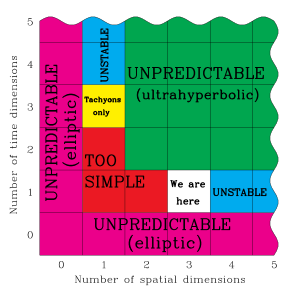
Diagram on the dimensionality of spacetime, by Max Tegmark
Posted by Keith Tidman
‘It is clear that the Earth does not move, and that it does not lie elsewhere than at the center [of the universe]’ 
— Aristotle (4th century BCE)

Almost two millennia after Aristotle, in the 16th century, Nicolas Copernicus dared to differ from the revered ‘father of Western philosophy’. Copernicus rattled the world by arguing that the Earth is not at the center of the universe — in a move that to many at the time seemed to knock humankind off its pedestal, and reduce it from exceptionalism to mediocrity. The so-called ‘Copernican principle’ survived, of course, along with the profound disturbance it had evoked for the theologically minded.

Five centuries later, in the early 1970s, an American astrophysicist called Brandon Carter came up with a different model — the ‘anthropic principle’ — that has kept philosophers and scientists debating its significance cosmologically and metaphysically. With some irony, Carter proposed the principle at a symposium to mark Copernicus’s 500th birthday. The anthropic principle points to what has been referred to as the ‘fine-tuning’ of the universe: a list of cosmological qualities (physical constants) whose extraordinarily precise values were essential to making intelligent life possible.

Yet, as Thomas Nagel, the contemporary American philosopher, suggested, even the physical constants known to be required for our universe and an intelligent carbon-based life form need to be properly understood, especially in context of the larger-scaled universe:
‘One doesn’t show that something doesn’t require explanation by pointing out that it is a condition of one’s existence.’
The anthropic principle — its adherence to simplicity, consistency, and elegance notwithstanding — did not of course place Earth back at the center of the universe. As Carter put it, ‘Although our situation is not necessarily central, it is inevitably privileged’. To widen the preceding idea, let’s pose two questions: Did the anthropic principle reestablish humankind’s special place? Was the universe made for us?

First, some definitions. There are several variants of the anthropic principle, as well as differences among definitions, with Carter originally proposing two: the ‘weak anthropic principle’ and the ‘strong anthropic principle’. Of the weak anthropic principle, Carter says:
‘… our location in the universe [he was referring to the age of the universe at which humankind entered the world stage, as well as to location within space] is necessarily privileged to the extent of being compatible with our existence as observers.’
Of the strong anthropic principle, he explained,
‘The universe (and hence the fundamental parameters on which it depends) must be such as to admit the creation of observers within it at some stage’.
Although Carter is credited with coining the term ‘anthropic principle’, others had turned to the subject earlier than him. One in particular among them was the 19th-century German philosopher Arthur Schopenhauer, who presented a model of the world intriguingly similar to the weak anthropic principle. He argued that the world’s existence depended on numerous variables, like temperature and atmosphere, remaining within a very narrow range — presaging Carter’s fuller explanation. Here’s a snapshot of Schopenhauer’s thinking on the matter:
‘If any one of the actually appearing perturbations of [the planets’ course], instead of being gradually balanced by others, continued to increase, the world would soon reach its end’.
That said, some philosophers and scientists have criticized the weak variant as a logical tautology; however, that has not stopped others from discounting the criticism and favoring the weak variant. At the same time, the strong variant is considered problematic in its own way, as it’s difficult to substantiate this variant either philosophically or scientifically. It may be neither provable nor disprovable. However, at their core, both variants (weak and strong) say that our universe is wired to permit an intelligent observer — whether carbon-based or of a different substrate — to appear.

So, what kinds of physical constants — also referred to as ‘cosmic coincidences’ or ‘initial conditions’ — does the anthropic principle point to as ‘fine-tuned’ for a universe like ours, and an intelligent species like ours, to exist? There are many; however, let’s first take just one, to demonstrate significance. If the force of gravitation were slightly weaker, then following the Big Bang matter would have been distributed too fast for galaxies to form. If gravitation were slightly stronger — with the universe expanding even one millionth slower — then the universe would have expanded to its maximum and collapsed in a big crunch before intelligent life would have entered the scene.

Other examples of constants balanced on a razor’s edge have applied to the universe as a whole, to our galaxy, to our solar system, and to our planet. Examples of fine-tuning include the amount of dark matter and dark energy (minimally understood at this time) relative to all the observable lumpy things like galaxies; the ratio of matter and antimatter; mass density and space-energy density; speed of light; galaxy size and shape; our distance from the Milky Way’s center; the sun’s mass and metal content; atmospheric transparency . . . and so forth. These are measured, not just modeled, phenomena.

The theoretical physicist Freeman Dyson poignantly pondered these and the many other ‘coincidences’ and ‘initial conditions’, hinting at an omnipresent cosmic consciousness:
‘As we look out into the universe and identify the many accidents of physics and astronomy that have worked together to our benefit, it is almost as if the universe must in some sense have known we were coming.’
Perhaps as interestingly, humankind is indeed embedded in the universe, able to contemplate itself as an intelligent species; reveal the features and evolution of the universe in which humankind resides as an observer; and ponder our species’ place and purpose in the universe, including our alternative futures.

The metaphysical implications of the anthropic principle are many. One points to agency and design by a supreme being. Some philosophers, like St. Thomas Aquinas (13th century) and later William Paley (18th century), have argued this case. However, some critics of this explanation have called it a ‘God of the gaps’ fallacy — pointing out what’s not yet explained and filling the holes in our knowledge with a supernatural being.

Alternatively, there is the hypothetical multiverse model. Here, there are a multitude of universes each assumed to have its own unique initial conditions and physical laws. And even though not all universes within this model may be amenable to the evolution of advanced intelligent life, it’s assumed that a universe like ours had to be included among the infinite number. Which at least begins to speak to the German philosopher Martin Heidegger's question, ‘Why are there beings at all, instead of nothing?’

Recent Comments